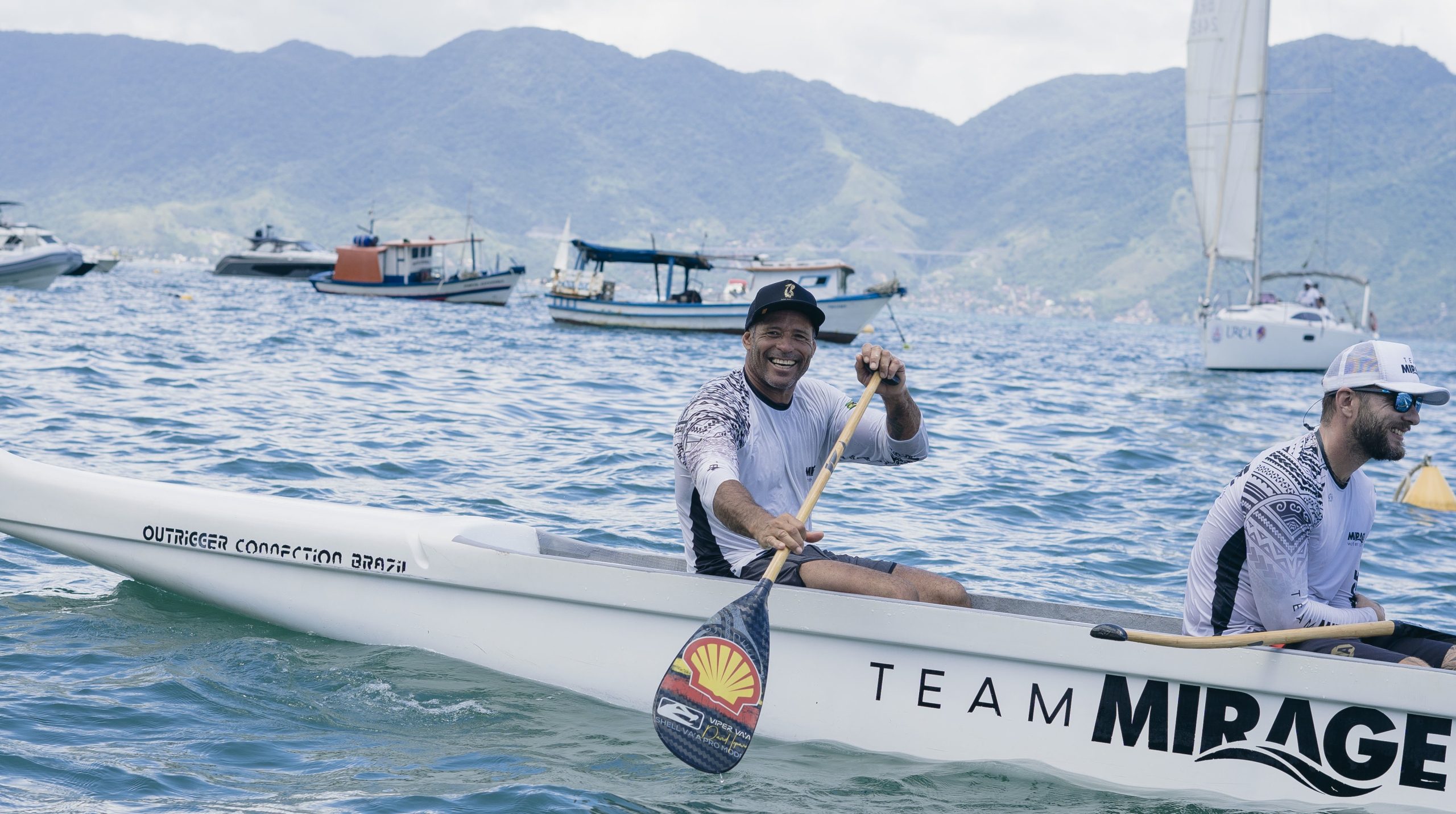
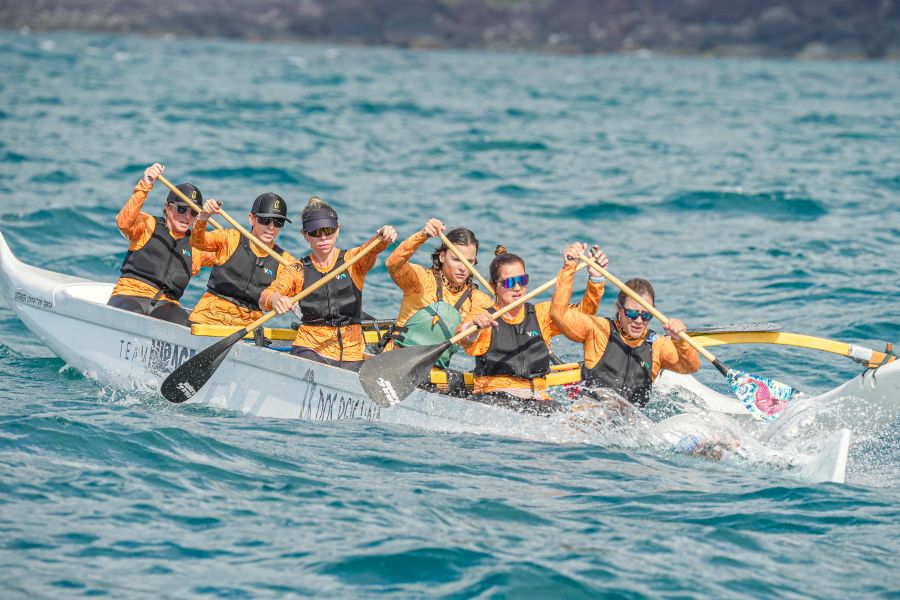
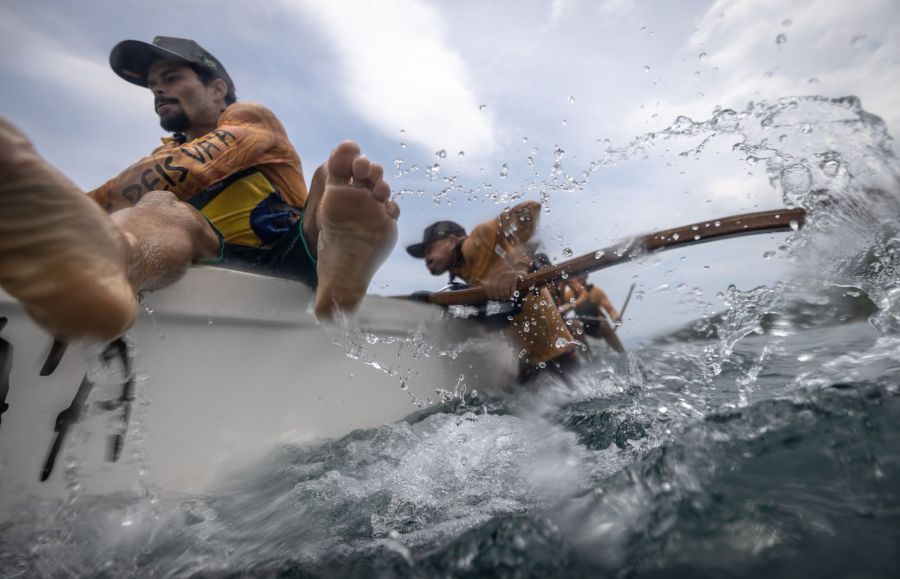
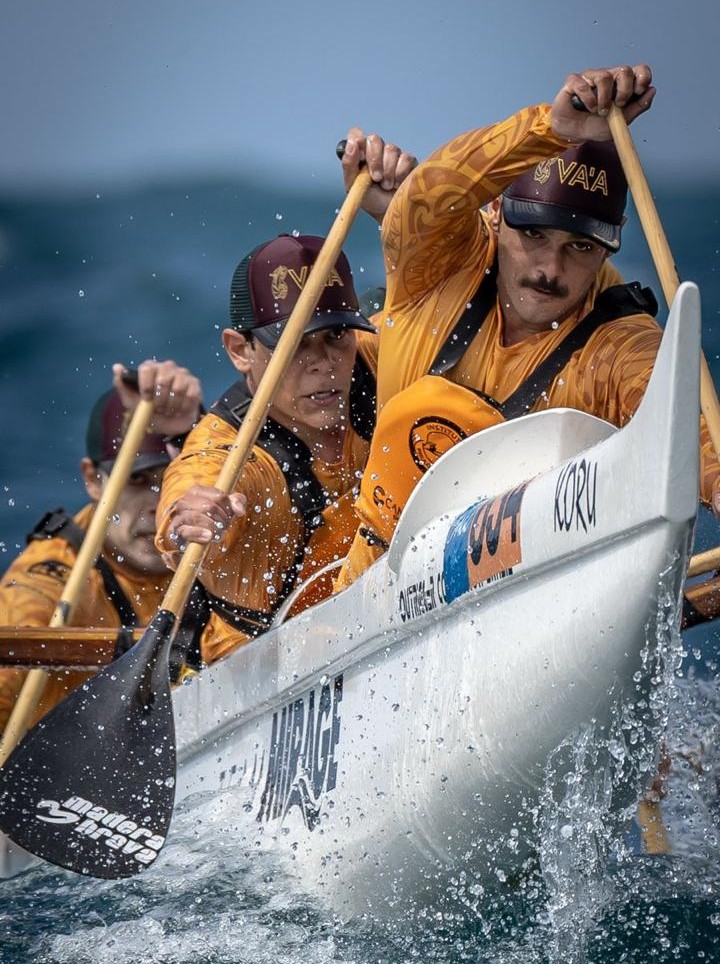
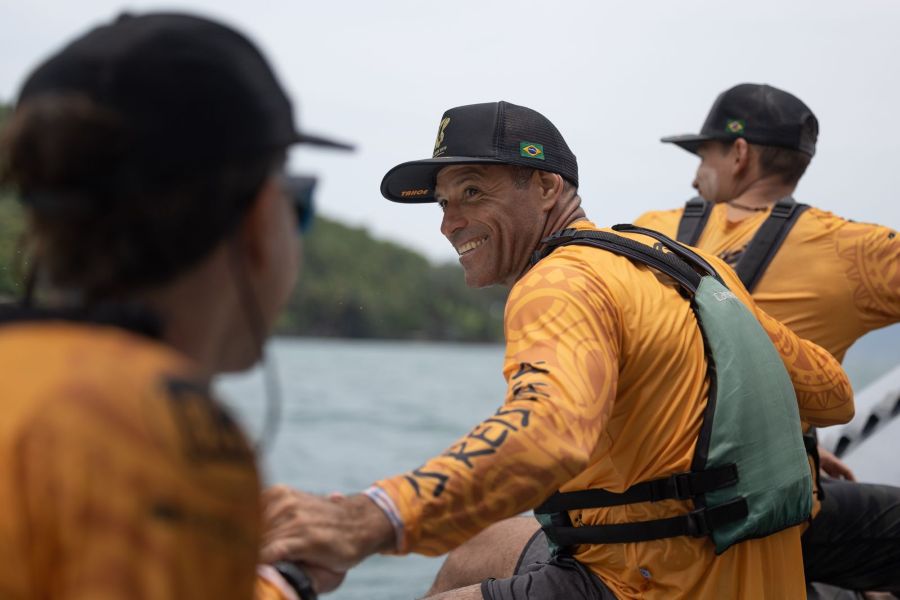
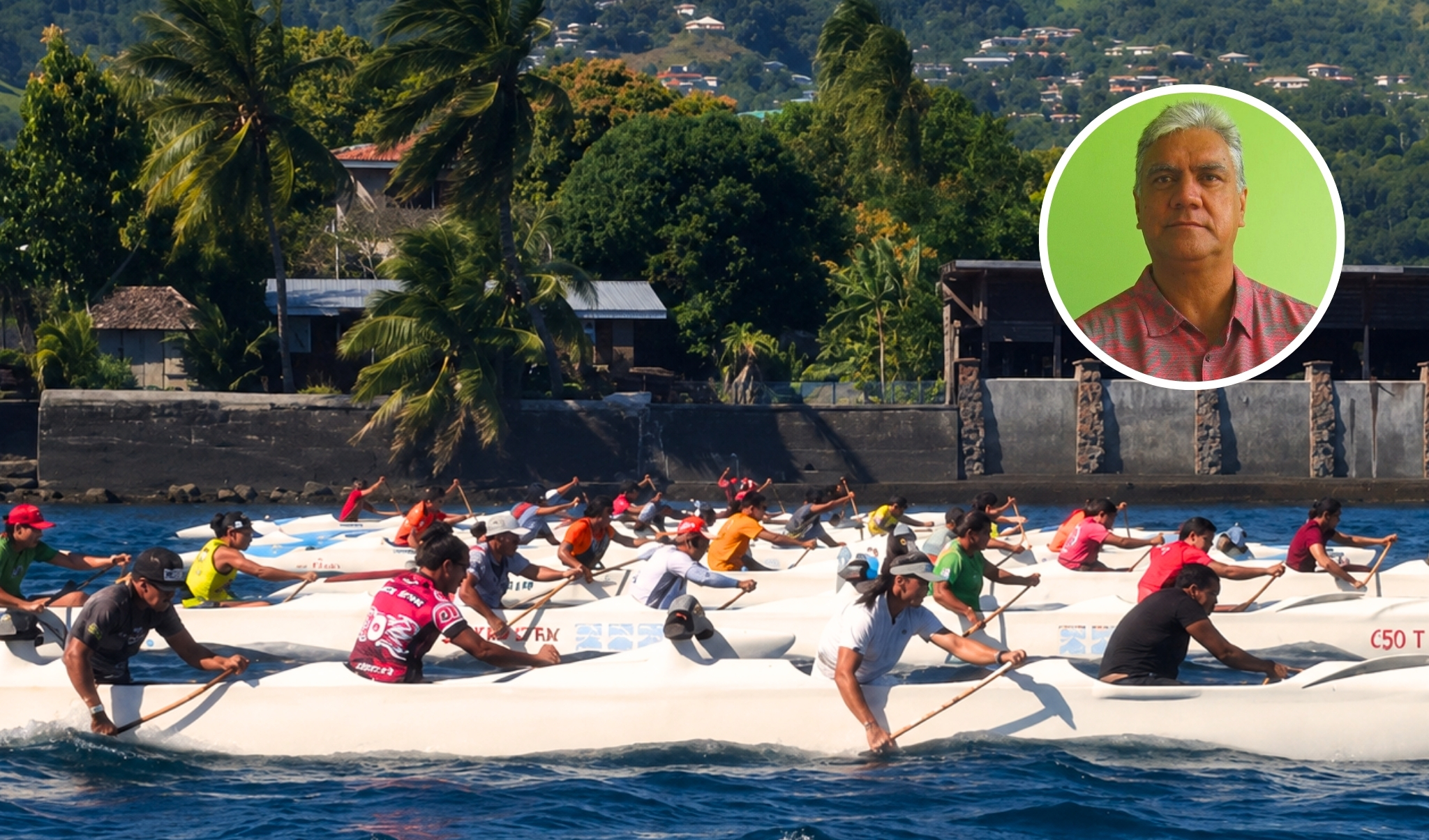
Brazilian paddler and coach Paulo dos Reis, known as Paulão, is one of the most experienced paddlers in Brazil. Based in Ilhabela, São Paulo, he has a unique perspective on the local waters and the challenges of ocean paddling. As someone who has taken part in every edition of the VIBE – Volta de Ilhabela, he has witnessed how the race has evolved over the years.
In this guide, Paulo shares the knowledge gained through years of experience on the water, offering insights into the race’s 90 km relay format, ocean conditions, team strategy, preparation and the practical challenges of paddling around Ilhabela. His perspective offers valuable advice for teams looking to take on one of Brazil’s most iconic ocean paddling races.
How did you get started in outrigger canoeing, and what was your journey like from becoming an athlete to working as a coach? What are the main individual titles and achievements of your career?
I was a professional windsurfing athlete for many years and competed on the world circuit for approximately 15 years. I won eight Brazilian titles, four Pan-American titles, three North American titles and one world title. I also topped the world rankings for two years.
In 2011, I started practising stand-up paddleboarding and, almost at the same time, had my first experiences with outrigger canoeing. At that time, I was very focused on SUP because I could see the sport growing and gaining visibility. My goal was to compete on the Brazilian circuit, so I started training intensively and competed in the Brazilian Stand Up Paddle Championship for five years.
I managed to break the dominance of Luiz Carlos Guida, known as “Animal”, who was the reigning Brazilian champion. I won the Brazilian title in the Elite category, which at the time was raced on 12’6 boards and was the circuit’s main category. Later, the 14-foot category took over that position.
During that period, I was already coaching Guilherme dos Reis, who was 13 years old. When he turned 15, he became Brazilian champion. Gradually, I also began focusing more on outrigger canoeing, while windsurfing took a secondary role.
In 2015, I joined the SAMU team, which was one of Brazil’s strongest and most successful teams at the time. I was part of the group for five years, winning several Brazilian titles with the team and also competing in stand-up paddle events. Over time, I dedicated myself increasingly to canoeing.
Later, I was invited to became a partner at Base Alpha. In fact, the first canoe at Base Alpha was mine, and I still have it today. It was the canoe with which Base Alpha started its activities. After some time, we ended the partnership, and I began thinking about setting up my own club.
That is how the idea of Clube Dos Reis Va’a came about, at Praia da Armação, at BL3, in Ilhabela. BL3 has always been an important place for me because I did a lot of windsurfing training in that area. Today, Clube Dos Reis Va’a is based there.
As for my individual canoeing results, after my time in stand-up paddleboarding, I started competing in OC1. At the time, MuriloPinheiro was the reigning Brazilian champion. After two years of competition, I managed to win the Brazilian title, beating the defending champion. I competed in OC1 for approximately three years.
Then I went to Tahiti and had my first experience with V1. At that point, I realised how much I needed to improve my navigation skills in a single canoe. V1 gave me a new perspective on technique, sensitivity and reading the ocean. OC1 has a rudder system controlled by foot pedals, which creates a different dynamic, while V1 requires an even stronger connection with the ocean and a more refined feel for the stroke.
I bought a V1 and started a new chapter in the discipline. I won three consecutive Brazilian titles in the Open category. Later, when I moved into the Master category, I continued winning practically every championship I entered. Next year, I will move into a new age category, Master 50+.
At the world championships, I have won three V1 Long Distance medals, as well as other medals at sprint world championships. At the Va’a Sprint World Championships in London, I won seven medals in total, across both club competitions and the Elite category, including the Master and Open V6 events.
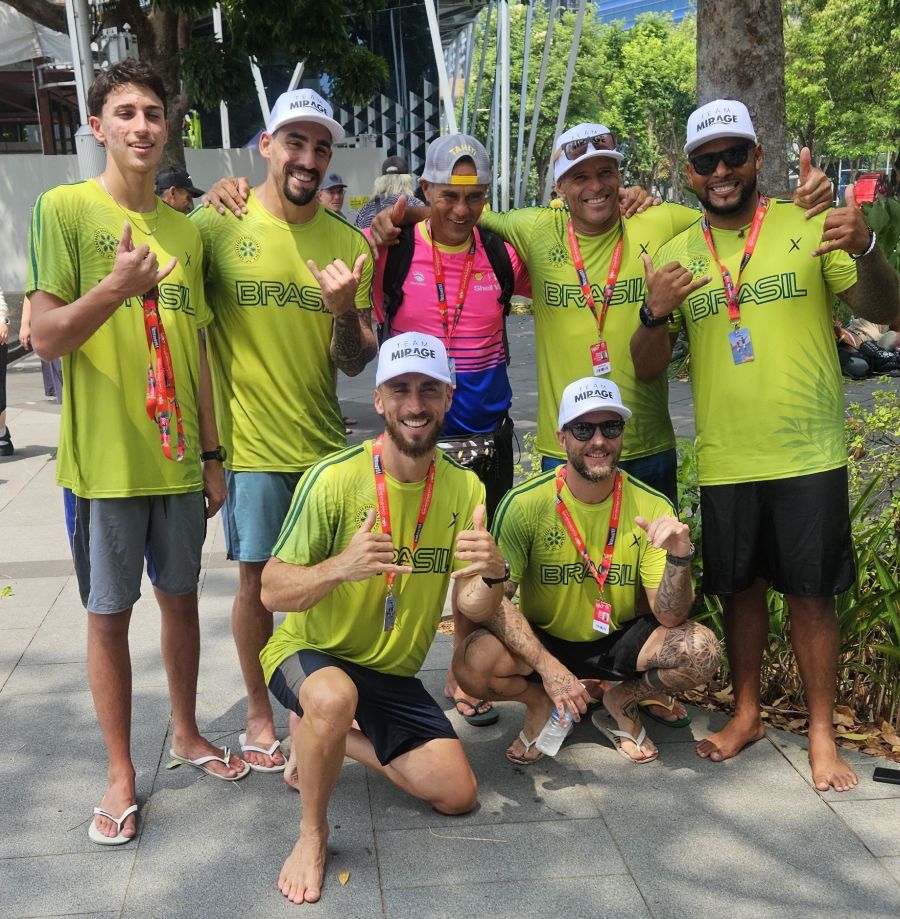
More recently, I competed at the Va’a Sprint World Championships in Singapore with Team Mirage in the Elite category, where we won the bronze medal. It was a historic result for Brazil.
You now have your own club in Ilhabela and work as a coach. What philosophy guides your work, and how has David Tepava influenced your approach to training?
We founded the club in 2019, and our main goal is to help people connect with the ocean and with Va’a in an enjoyable way. We want them to develop their ability to read the sea, understand the true purpose of the canoe and recognise that it represents a connection between people as well as a lifestyle.
We always place great importance on technique, but we believe that, before that, it is essential to share the philosophy behind canoeing. Connection is fundamental to helping people understand what Va’a really represents.
For us, canoeing is a lifestyle and a way to improve quality of life. It is like having a gym in the ocean, where you exercise outdoors and stay in direct contact with nature. That is what we value most at our club.
About two and a half years ago, we came into contact with David Tepava, and that experience made a huge difference to us. Later, I joined Team Mirage, with whom I paddled for five years. During that time, we learned more about Tepava’s work, particularly his experience and the philosophy developed at Shell Va’a.
We learned a great deal from him. Our technical knowledge, philosophy, understanding of the stroke, communication and team-building skills all improved significantly. I consider that experience a real turning point for everyone who took part in the training immersion.
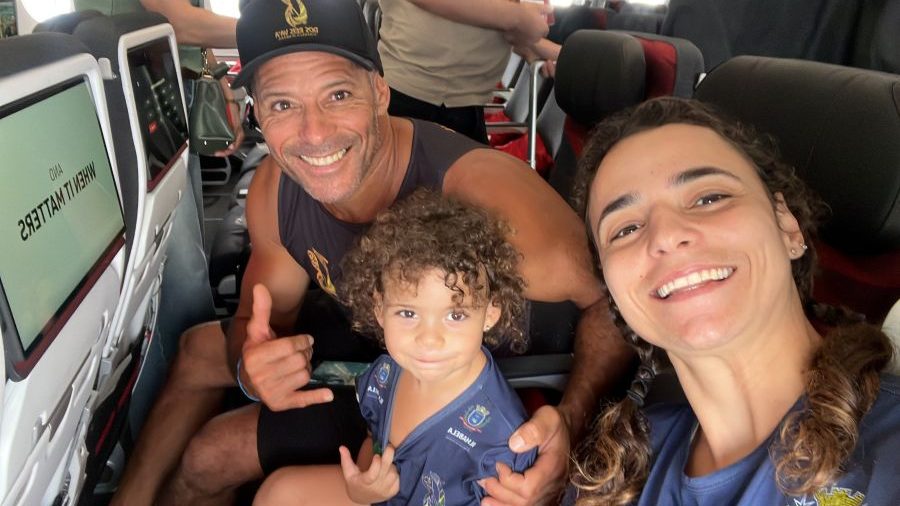
After that, I travelled to Tahiti with my wife, Luana, and my daughter, Dandara. We spent three months training at Shell Va’a under Tepava’s guidance. It was an extraordinary experience, made possible through the connection established by Naideron, from Passaúna Composite, together with Team Mirage. That opportunity made all the difference to our development.
How did your journey with Team Mirage begin? How did this partnership come about, and what led you to join one of the leading teams in Brazilian outrigger canoeing?
The opportunity to join Team Mirage came during preparations for the 2019 World Championships in Australia. Henrique Vogel, the team’s captain, needed an athlete because one of the team members was unable to obtain a visa to travel. Since I was already going to Australia to compete in the individual canoe world championship, he asked me if I could join the team.
I was delighted to receive the invitation. It was an honour for me to take part. That was my first contact with the He’eNalu team.
After that, I continued developing my work with Equipe Dos Reis Va’a and the younger athletes in Ilhabela. For four years, I focused on strengthening the club’s programme. Henrique always kept the door open and continued inviting me to join the team again.
At a certain point, an opportunity came up for us to combine our teams. Henrique was planning to compete in the Volta à Ilha with Team Mirage, from He’eNalu, and needed four athletes. We managed to bring together four paddlers from Equipe Dos Reis Va’a and complete the crew with athletes from He’eNalu.
That was our first competitive experience with this line-up, and we managed to set a race record. The following year, we returned and broke our own record, which still stands today.
After that, I became part of Team Mirage, a group of athletes selected by Henrique to form the team.
After approximately four or five years with the group, I decided to continue strengthening the work of Equipe Dos Reis Va’a, while maintaining our connection with Team Mirage. We started developing this project with the club’s athletes and managed to become Brazilian vice-champions in the Elite category.
This year, we will return to the Volta à Ilha with Equipe Dos Reis Va’a / Team Mirage.
Throughout this partnership, you have achieved important results, including at the VIBE – Volta à Ilhabela. What have been your most memorable results with Team Mirage, and what makes this team stand out in competition?
Our most memorable achievement was the Pan-American Championship held in Vitória, where we managed to break the 12-year winning streak of the Rapa Nui team from Easter Island.
It was a great battle, with two high-level teams competing side by side. At the end of the race, we won the Pan-American title, bringing Rapa Nui’s winning streak to an end.
Within the team, after approximately a year or a year and a half, I took on the role of captain, paddling in seat three. For me, it was a great challenge to lead high-level athletes, motivate the team and bring out the best in every member to achieve good connection throughout the race.
We know that conditions at sea can vary during a competition. For a team to perform well, it is essential to understand what is happening and keep the canoe moving efficiently, whether we are facing upwind, crosswind or downwind conditions. The important thing is to maintain the connection between the paddlers in every situation.
I believe one of the main factors behind Team Mirage’s strength is the leadership of Henrique Vogel. He is the head coach and president of He’eNalu, as well as a great leader. He has a real ability to bring people together and guide the team.
Alongside the great athletes in the group, there is a combination of individual qualities that becomes something greater: a unified team. It is not simply about bringing together the best athletes, but about combining the best in each person and building a real team.
In my opinion, that is one of Team Mirage’s greatest strengths. The work developed with David Tepava was also, without a doubt, one of the major turning points in the team’s development.
You take part in several competitions, and the VIBE – Volta à Ilhabela is an important event on the calendar. What makes this 90 km race so special to you?
My first experience paddling around the island was on a stand-up paddleboard, in 2012, during an expedition organised by Alemão, from Maresias. It was an independent initiative and was not part of the organisation of today’s Volta à Ilha.
The route was divided into three stages. We left Praia do Engenho d’Água and headed towards Bonete, where we spent the night. The following day, we continued to Saco de Eustáquio, and on the third day we returned to Praia do Engenho d’Água for the finish.
There were 21 invited athletes, including a French paddler and Mo Freitas, a Hawaiian athlete who, at the time, was competing in the main stand-up paddle events alongside names such as Connor Baxter and Kai Lenny. There were also several Brazilian athletes.
Later, the idea of organising the Volta à Ilha emerged through Marina do Guna, when Reinaldo was still at Paddle Clube Ilhabela. I took part in the trial circumnavigation, which was organised to test the route and determine the best format for the race. There were approximately 12 athletes, including me, Alemão from Maresias, other paddlers from Paddle Clube Ilhabela, my son Guilherme dos Reis, and Itamar do Carmo, who is now also part of my team.
The experience was a success and gave rise to the Volta à Ilha project.
By that time, I had already left Paddle Clube Ilhabela and set up Base Alpha. For the first official edition in 2017, I trained 12 athletes to take part in the race. Our team became the first Volta à Ilha champions, with several local caiçara paddlers in that line-up.
I have taken part in every edition since the first official race. This will be the tenth edition and also my tenth participation.
Over the years, I also completed a circumnavigation of the island in a V1 with a friend. We set off during the early hours of the morning and completed the entire route in a single journey, with a support boat. We alternated our paddling shifts: I paddled 15 kilometres and he paddled 10 kilometres. We completed the circumnavigation in eight and a half hours.
For all these reasons, I consider it a great honour to have taken part in every edition. Regardless of which team I represent, I am always happy to be there and support the event.
The VIBE – Volta a Ilhabela is undoubtedly one of the biggest races in the world. It covers 90 kilometres in an incredible setting, and every section of the island has different characteristics, not only in terms of scenery but also navigation.
It is always a major challenge for any team. During the route, many situations can arise, such as an athlete becoming unwell on the support boat or changing sea conditions. That is why preparation is extremely important to completing the race successfully.
How do you organise training for a team of 12 athletes when it is not always possible for everyone to train together? How do you decide on the rotations, pace and changeover intervals?
I believe the biggest challenge for any team taking part in the VIBE is organising training sessions together. Over the years, I have realised that it is difficult to get all 12 athletes together to train at the same time. This is easier when everyone belongs to the same club and trains in the same area.
Nowadays, it is very difficult to find 12 athletes with a similar technical level within a single club for a race like this. That is why I consider preparation and athlete selection to be among the main challenges.
In training, we focus mainly on technique and how well the team fits together. We do not place as much importance on training volume or long sessions. We usually do one long training session per week, generally on Saturdays, while the other sessions focus on timing, harmony and team technique.
Mental preparation is also essential and receives considerable attention in our programme.
Changeover practice, for example, is important, but it can lead to injuries. For that reason, we do not prioritise excessive repetition of this exercise. Since we already have experience in several competitions, we try to focus our sessions on correcting details and improving movements, while avoiding unnecessary repetition of activities that can cause physical strain.
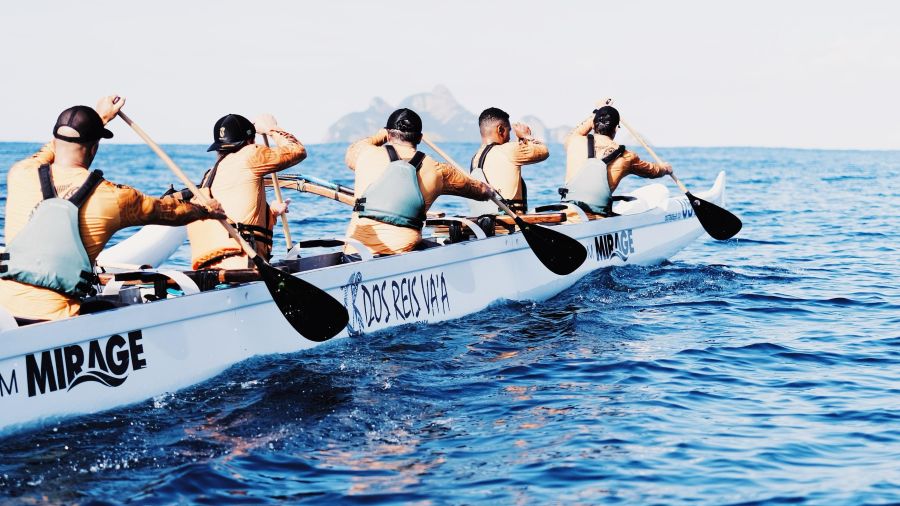
When it comes to rotations, there is a pattern commonly used by the top teams. For a 90-kilometre race with 12 athletes, we work with 20-minute periods in the canoe and 20 minutes on the support boat.
In my view, the less time an athlete spends on the boat, the better. The rest period needs to be long enough for them to hydrate, eat and take the supplements they need, but not so long that they completely lose the rhythm of the race.
Athletes should not simply lie down and rest. They remain involved in the race, following the team, encouraging their teammates, giving feedback to the paddlers in the canoe and contributing to communication. It is important that everyone remains actively involved.
The athletes in the canoe, meanwhile, need to maintain a strong pace throughout their 20-minute paddling shift. Even though this is a long-distance race, the pace changes constantly. The team needs to work at different intensities and use the paddling techniques they have practised, regardless of the sea conditions.
For teams travelling from outside the area, how does the logistics of securing canoes and support boats work? Do the clubs in Ilhabela offer this kind of support, and what needs to be organised in advance?
In our case, Clube Dos Reis Va’a will also have all its canoes on the water. In every edition we have taken part in, we have entered at least three teams, and we have competed with as many as four canoes. Because of that, it can be difficult to find canoes available for rent, especially good-quality boats.
On the other hand, there are clubs in the region that may be able to help. From Paraty and Ubatuba to Caraguatatuba, São Sebastião and Ilhabela, there are several clubs that teams travelling from outside the area can contact.
In São Sebastião, for example, there is Canoa para Todos, run by Geórgia. In Ilhabela, there is Base Alpha, Vento Sul in the southern part of the island, and Pirapuã in Vila. I believe these clubs are good options for teams looking to rent a canoe.
The most important thing is to get in touch well in advance and make arrangements directly with the owners. You need to establish whether the canoe will be transported to the starting point or made available on the beach, ready to use, with a bucket, drinks and all the necessary safety equipment.
It is also essential to check the condition and quality of the canoe, as well as the experience of the person providing it.
As for support boats, I believe they are a little easier to find in the region. Ilhabela has many boats used for tours, and several owners also make the Volta à Ilha a priority.
Since the race starts at six in the morning and the canoes generally return to their clubs at around two in the afternoon, the rental period is relatively short compared with a tour that takes up the entire day. This can also make renting out a boat an attractive option for its owners.
There are many hours at sea, with paddler changes, and a support crew is essential. How do you plan nutrition, hydration, communication and safety throughout the 90 km?
We usually calculate how much water and isotonic drink we will need to take, also considering each athlete’s hydration intervals.
It is essential to stay hydrated throughout the race and not wait until you feel thirsty to drink water. By the time we feel thirsty, we may already be becoming dehydrated.
I encourage my athletes to understand their own bodies because everyone is different. There is no single formula that works for everyone. The most important thing is for each person to recognise their own needs and avoid any drop in performance during the competition.
In such a long race, it is necessary to keep the body properly hydrated, fuelled and supplemented. Whenever an athlete gets onto the support boat, it is also important to use fresh water to cool the face, avoid direct sun exposure and stay protected, preferably under the boat’s canopy.
Safety is one of my biggest concerns. We always hold a briefing with the team before the race and also with the person responsible for the support boat. Our boat driver is usually a sailor friend with plenty of experience and knowledge of the sea. He provides support, but he also takes an active part in our preparation.
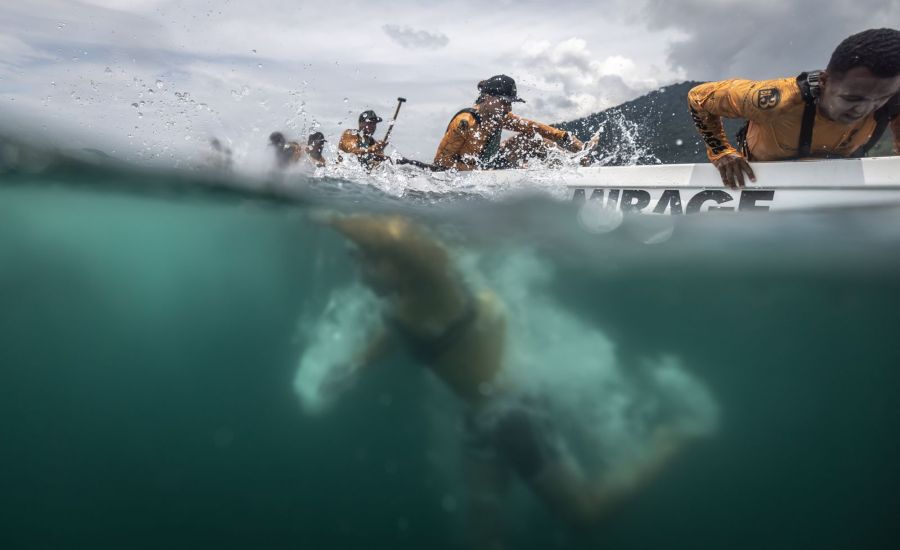
During the briefing, we discuss safety in detail and go through all the procedures: how to get off the support boat, how to get into the canoe and how to return to the support vessel.
We need to stay alert and look out for one another throughout the route. Regardless of each athlete’s experience, everyone can help prevent accidents.
We also need to pay attention to the other teams taking part in the race. If someone needs help, we are prepared to stop competing and provide assistance. Safety must always come first in any sport.
The VIBE circumnavigates Ilhabela, where conditions can change significantly along the route. What conditions should athletes expect, and what should they know about wind, currents, swell and weather changes before taking on the 90 km?
Normally, the race’s Plan A is to complete the route in an anticlockwise direction. The start takes place near Praia do Itaquanduba, close to Perequê, heading towards the southern part of the island.
Conditions can change completely along the route. In some editions, for example, we started with almost no wind and very flat water, like a swimming pool. However, we knew there was significant swell offshore because it had been very windy during the previous night.
When we reached the Ponta da Sela area, beyond the lighthouse, we found completely different sea conditions. The change was impressive.
That is why teams travelling from outside the area need to understand that the conditions at the starting point do not necessarily reflect what they will encounter on the other side of the island.
Every headland can bring a surprise, whether because of the wind, swell or ocean currents. It is essential to study these variations before the race.
Those of us who know the area try to understand the behaviour of the currents along every section of the route. Since the course goes around the island, currents, swell and wind can vary significantly from one point to another.
I recommend that teams study the route carefully, using Google Maps to visualise the course and Windy to check the wind forecasts. This planning is important both for those who already know Ilhabela and for those travelling from other regions.
As well as checking forecasts, athletes need to develop an understanding of the actual conditions during the race. We cannot rely exclusively on what we see in apps. Nature is constantly changing, and we need to stay connected to those changes and be ready to adapt.
I also believe that any team planning to take part in the VIBE needs consistent preparation and experience in the sport. In my opinion, athletes should have at least five years of outrigger canoeing experience.
With that level of experience, an athlete will have developed skills that can make a significant contribution to the team, not only in paddling but also in reading the ocean and understanding the sport.
Alongside physical preparation, technical knowledge is essential for making the race enjoyable and safe. The goal is to complete the course within the required time, even in challenging conditions, and enjoy the event, which I consider the best race of the year.
In your experience, what factors have the greatest influence on a team’s performance in the VIBE?
I believe experience and mental preparation are essential. An endurance race is completely different from a sprint competition. Athletes need to be prepared for a long-duration challenge, both physically and mentally.
Nutrition strategy, rest, sleep and the entire planning process also have a direct influence on performance. This preparation starts even before arriving in Ilhabela. Teams need to organise their trip in advance, arrive a few days early whenever possible and allow themselves time to adapt to the local conditions.
On the eve of the race, it is important to go to bed early and pay attention to hydration and nutrition. We know this can be more difficult for athletes travelling from far away, but it is part of the preparation.
Another essential factor is organisation on the support boat and sticking to the team’s plan. It is important to establish a strategy and do everything possible to ensure that everyone can follow it.
Changeover timing is extremely important. We also need to pay attention to how the two groups of athletes are put together. In a team of 12, there are six paddlers in the canoe and six on the support boat. It is essential that the two groups have a balanced performance level.
Having one very strong group and another much weaker one can compromise the entire strategy. This imbalance can affect performance and even cost a team the chance to compete for the title. That is why both groups need to be capable of maintaining similar performance levels.
Reading the ocean and planning the navigation strategy also make a big difference. It is essential to understand exactly which line the team will follow during the race.
Since we are paddling around an island, the route needs to be carefully planned. A small navigation error may be manageable, but accumulating mistakes across different sections can seriously affect a team’s chances of competing for the title.
These are details that make a huge difference over such a long course.
For teams travelling from other cities and countries, is it possible to arrive before the race or stay afterwards and train with you? How does this preparation work, and how can interested athletes arrange it?
Absolutely. This is possible, as long as it is organised in advance.
Clube Dos Reis Va’a usually has a busy weekly schedule focused on team training. As a coach, I also need to dedicate a lot of time to that work, but I can welcome athletes and teams travelling from outside the area for specific training sessions.
This year, exceptionally, our schedule will be a little different because we will be returning from Porto Seguro, where we will take part in the Pan-American Championship. We will make the return journey by car, and I will probably arrive in Ilhabela only a few days before the race.
Even so, it may be possible to organise some training for those travelling from outside the area. After the VIBE, I believe it will be even easier, as I will have more availability to help athletes who want to train with me at the club.
Just get in touch with me directly or contact Luana at Clube Dos Reis Va’a, and we can arrange the details.
We can work on technique, strategy or other aspects that could make a difference to race preparation and planning for the next season.
I would also like to thank you very much for the invitation and the opportunity to take part in this article. I hope I have contributed in some way to the growth of the sport. My goal is to add value and share some of the knowledge I have gained throughout my journey, while also helping people who are just getting started in the discipline.
You are doing an incredible job promoting and supporting the sport, not only outrigger canoeing but also SUP and other disciplines. It is great to see this growth.
I hope to continue contributing in some way to the development of the sport.
Thank you very much for the opportunity. All the best!
VIBE – Volta de Ilhabela 2026: Registration is Open
Registration is now open for the VIBE – Volta de Ilhabela 2026! The main race takes place on December 5, with event activities for participants also scheduled for December 4, in Ilhabela, São Paulo, Brazil. The challenge is to complete the 90-kilometre course around the island, in a special edition celebrating ten editions of the event.
Registration is available through Ticket Sports. For race updates and further information, follow the official Instagram account: @vibeilhabela.
To learn more about Paulo dos Reis and the activities of Dos Reis Va’a, follow their Instagram account: @dosreisvaa.
The Hawaiki Nui Va’a 2026 took place from October 28 to 31, 2026, in French Polynesia. Now in its 33rd edition, this iconic outrigger canoe race brings together crews from Tahiti, other Pacific islands and international clubs to compete across the waters of Huahine, Raiatea, Taha’a and Bora Bora. The main V6 marathon covers approximately […]
The 2026 MolokaBRA brought international attention to Ceará, Brazil, as Fortaleza hosted a round of the Surfski World Cup and welcomed elite paddlers from around the world. The event placed the Fortaleza–Cumbuco coastline at the centre of the international Ocean Racing scene, highlighting a destination that is becoming increasingly relevant to the sport. For Sebastián […]
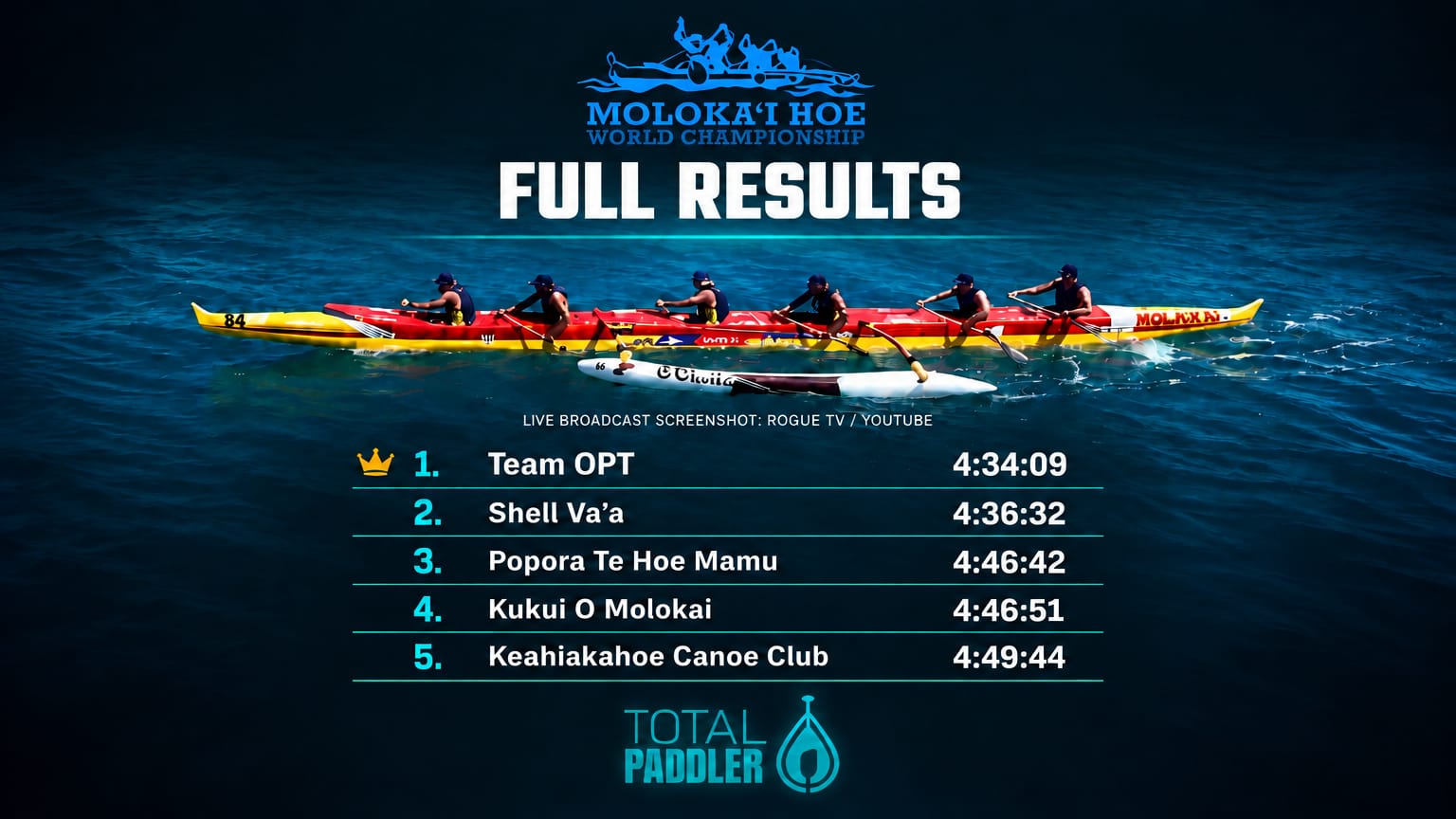
On Sunday, October 11, the world’s elite outrigger canoe paddlers take on one of the most demanding challenges in ocean racing: the legendary crossing of the Kaiwi Channel. From the shores of Molokaʻi to the finish line in Waikīkī, Oʻahu, the Molokaʻi Hoe World Championship brings together the strength, strategy, endurance, and teamwork that define […]
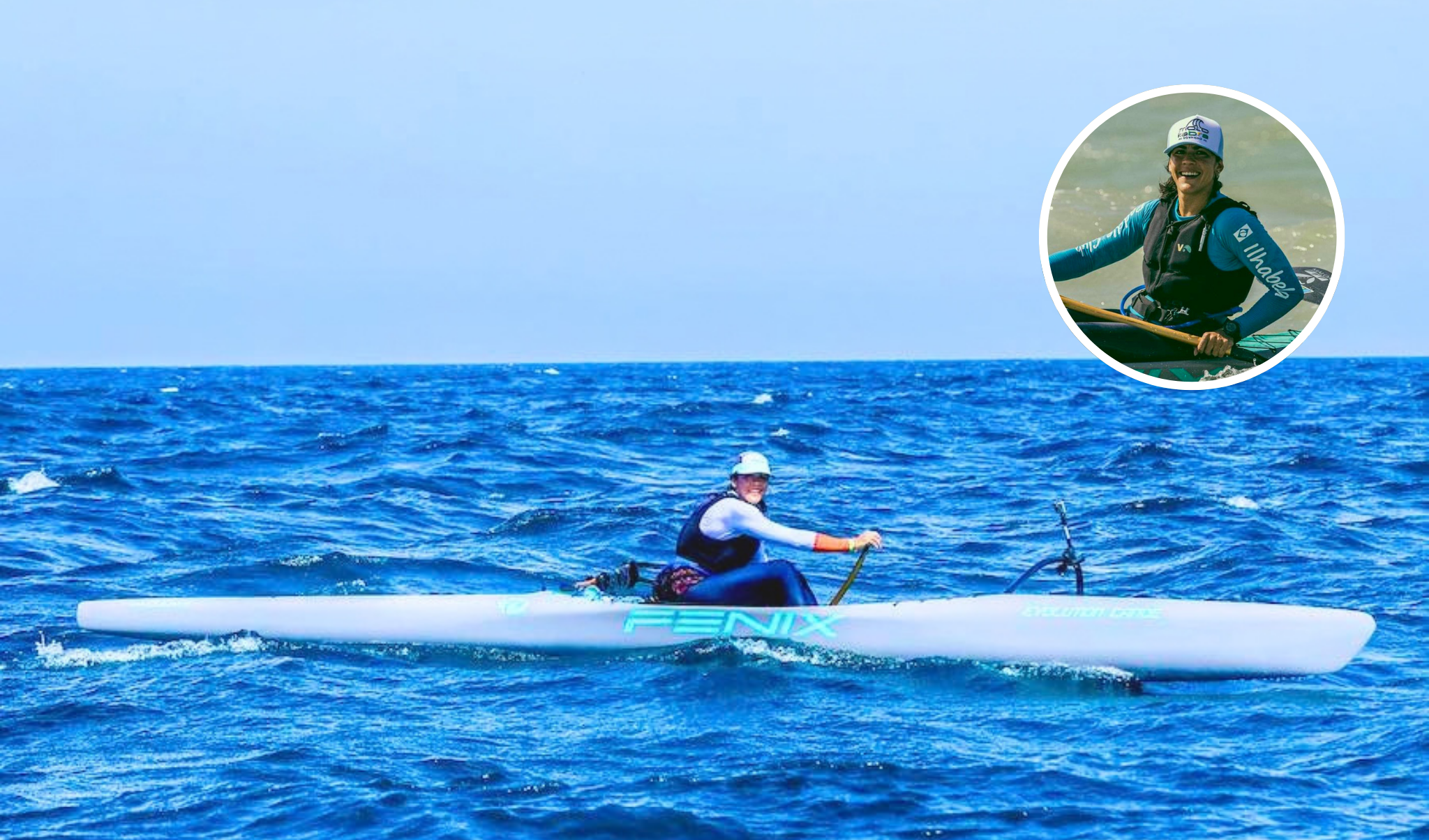
For Maria Clara, Molokabra isn’t just another stop on the calendar, it’s practically a homecoming. Now competing for her third consecutive year, the Brazilian paddler arrived in Ceará fresh off a rainy stretch in Ilhabela and stepped straight into the trade winds she’s come to know so well. Her opening descent delivered a personal-best top […]
Welcome to MolokaBRA Downwind 2026! Welcome to Ceará, Brazil, for the 8th edition of MolokaBRA Downwind — one of the biggest downwind events in Latin America and a major gathering for ocean paddling. Taking place from September 18 to 27, 2026, along the Ceará coastline, MolokaBRA brings together athletes from Brazil and around the world […]
Imagine remar ao redor de uma ilha no Oceano Atlântico, percorrendo 90 quilômetros em revezamento e enfrentando vento, ondas, correntes e diferentes condições de mar ao longo do caminho. Essa é a VIBE – Volta de Ilhabela, uma prova de longa distância realizada em Ilhabela, no litoral do estado de São Paulo, Brasil. Ao longo […]
Depuis près de quarante ans, le nom de Te Aito résonne comme une évidence dans l’univers de la pirogue. Née en 1988, la course s’est peu à peu imposée comme l’un des rendez-vous les plus attendus du va’a mondial, forgeant au fil des éditions certains des plus grands champions de la discipline. Et l’actualité du […]
Iloha Eychenne claimed an impressive victory in the women’s race at stop #2 of the ICF Canoe Ocean Racing World CUP Tahiti, finishing well ahead of the rest of the field after 23 kilometres of open ocean and lagoon paddling. But for the waterwoman, 3 x Va’a World Champion among other accolades, the result represented […]
With the 2026 World Srint Championships in Singapore just weeks away, the Tahitian Va’a selection is entering the final stages of its preparation. During the team’s penultimate training session in Tahiti, we caught up with Gordon Barff, Technical Director of the Tahitian Va’a Federation, to discuss the selection process, the challenge of bringing together the […]