Passionate about the ocean and driven by a strong competitive spirit, this French paddler Thomas Buton and Nalu’s Canoes team rider has built an impressive journey in outrigger canoeing since discovering the sport in 2010. After many years playing American football, he turned to the water in search of a new challenge and quickly fell in love with the unique mix of team spirit, ocean knowledge, and endurance that defines the discipline. Based in Toulon, where the bay offers ideal conditions for paddling and downwind runs, he has gone on to become a multiple French champion and a respected figure in the sport. Beyond the titles, he values sharing the ocean, human connections, and the adventure that paddling brings. In this interview, he reflects on his career, his philosophy, and his passion for outrigger canoeing.
How did you discover outrigger canoeing?
I discovered outrigger canoeing in 2010 after having played American football for many years. I’m actually still coaching the Toulon team today. When I retired, I was looking for a new sport to replace football. I’ve always been close to the ocean and grew up in that environment. Some friends of mine were already paddling, so naturally I decided to give it a try and I immediately fell in love with it.
At first, it was the crew aspect that attracted me. I found the same team spirit that I had experienced in American football. Then my competitive side quickly took over, and I started racing in the individual category.
I’m also lucky to live in a bay that is perfect for paddling, with one side always sheltered from the wind and great opportunities for downwind paddling, which makes the sport even more fun.
Was there a race or a moment that marked a turning point in your career?
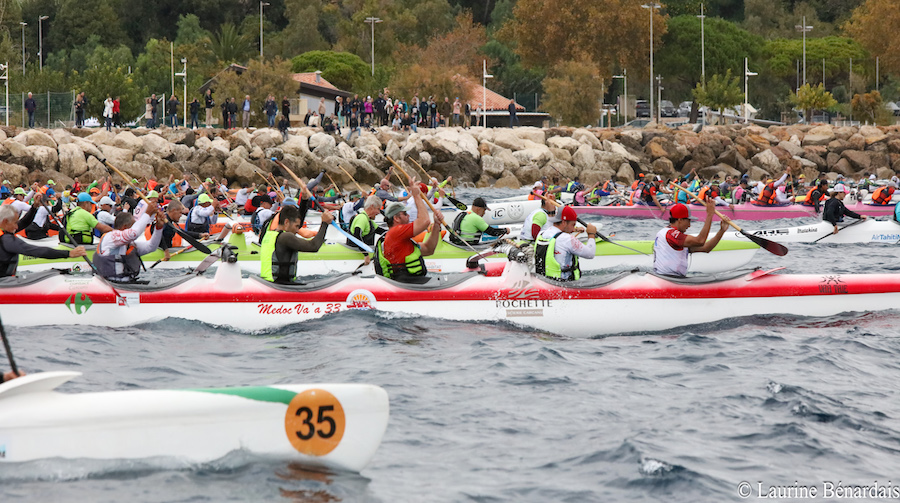
I would say my first French Championship title in 2018. My son had been born just two and a half months earlier, and the race took place in Toulon on a downwind course. I went there without much preparation and after many short nights.
I was in third place just a few hundred meters from the finish, but then two magical waves connected perfectly, allowing me to overtake just before the finish line. It’s a feeling that’s very hard to describe.
Since then, I’ve been lucky enough to race in many major events in France and abroad, and every race brings its own emotions.
What is your history and relationship with Nalu? How did you first come across the brand?
After years of racing and seeing Marton’s canoe next to mine, I naturally became interested in his brand and his boats. At one point, when I wasn’t paddling much because of a shoulder injury, I reached out to him. He then made one of his canoes available to me, which was awesome, and even more so at that time.
What’s great about Marton is that he’s a paddler himself. He truly understands the challenges athletes face and is deeply involved in the development of his boats. He also makes his full range available so people can try the equipment and form their own opinion.
You have several French championship titles. Do you have a favorite race format, or one where you feel more comfortable?
Yes, I’m clearly more comfortable in long-distance races, although that might come with age.
If you add navigation and downwind conditions, those are definitely my favorite scenarios. That’s where experience and ocean knowledge can sometimes compensate for pure physical power.
And of course, downwind races are always the most fun, with incredible sensations on the water.
You also paddle in crew boats. What would your dream crew lineup look like? You can mention names.
That’s a big question. It depends whether we’re talking about the French level or the international level, and it also depends on the sea conditions.
Without necessarily giving names, the most important element for a successful crew is having people who get along well. More important than performance or results is the human adventure. That’s what can make a race either an incredible experience or a nightmare.
I’ve seen crews finish near the back of the Hawaiki Nui but still have a better experience than teams finishing far ahead.
Training together is also key. You need to spend time on the water together, both individually and as a crew, so that everything comes together on race day.
Finally, in surf conditions, the steerer makes a huge difference. I had the chance to race with Manutea Millon, one of the best Tahitian paddlers, and it changes everything.
When it comes to equipment, can you tell us about your gear and what is essential to perform well?
When it comes to equipment, I’m lucky to have the trust of Eva and Marton from Nalu Canoes Their boats are extremely well built and very high-performing. You can feel that they are designed by someone truly passionate who is on the water every day.
He is one of the most competitive paddlers in Europe today, and you can clearly see it in the performance and design of the boats.
In fact, I have the entire range at home, so if anyone wants to come and try them, they’re welcome to do so.
But what’s really essential for performance is spending time on the water: knowing your boat, understanding your local conditions, and developing a true feeling for the ocean.
You often see exceptional athletes who lack that ocean feeling, and their performances can be less impressive than expected.
Can you detail every canoe of the Nalu fleet based on your experience?
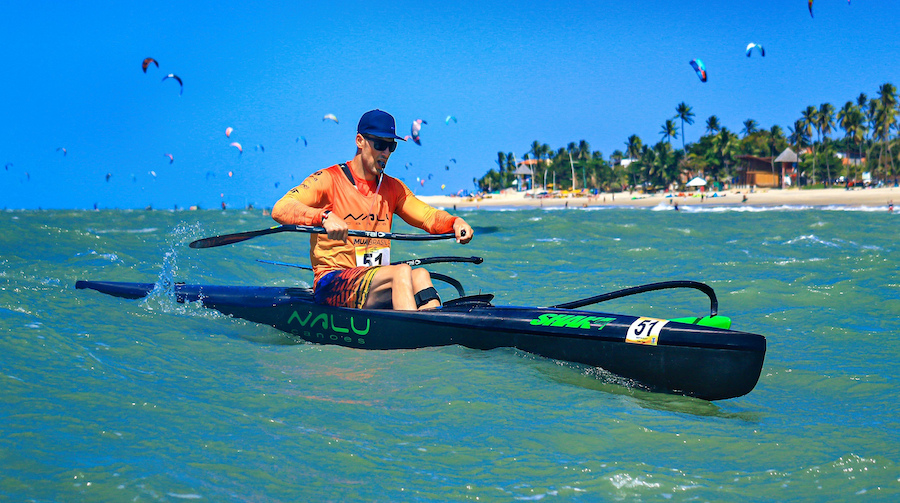
The Supersonic is the boat for those who want to race. It’s very high-performing, especially in Mediterranean conditions and on flat water, while still remaining maneuverable in downwind. The hull speed is optimal in these conditions. Its only minor drawback is in very large swells, but for the Mediterranean sea, it’s the perfect compromise.
The Supernova is ideal for smaller paddlers. Very playful, yet still performs well even for heavier paddlers. Its more compact size also makes it easier to steer.
The Synergy is a boat that’s surprisingly maneuverable for an OC2. It almost feels like paddling an OC1.
The Shaka is the only canoe I don’t have at home but having tested it, I can affirm it is a pure downwind model. It has significantly more rocker, designed to handle stronger downwind conditions.
The boats are built using autoclave construction, which ensures high quality and lightweight construction. Several paint options are available, and it’s also possible to choose a raw carbon finish to reduce weight
In your opinion, what is the most underestimated element for success in outrigger canoeing?
In my opinion, the most underestimated element is everything that happens before the race.
Many paddlers start a race without really knowing the course. But preparation and information are key. At equal physical levels, the paddler who knows the course, understands the weather, and anticipates the currents will always have an advantage over someone who simply jumps into the canoe without preparation.
What projects outside of competition are important to you?
I really enjoy sharing the sport and paddling with others. As I mentioned earlier, we are lucky to live in a beautiful paddling location.
I have a small guesthouse in my garden, and it’s always a pleasure to welcome paddlers who stop by and share sessions on the water.
As I’m getting older, the part of the sport outside competition is becoming more and more important to me. In fact, it’s probably the most meaningful part now: the exchange and sharing around a common passion.
What values do you want to pass on to young paddlers or people who are just starting in the sport?
Sharing, enjoying the ocean, and appreciating the precious moments our sport gives us.
And above all, never forget that the most important thing is not the results or medals, but the moments that surround them.
When you are 80 years old and look back on your life, you won’t remember your titles or trophies, you will remember the moments shared and the adventures lived with others.
Entre voyages aux quatre coins du monde, compétitions internationales et conditions extrêmes, Thaïs Delrieux a vécu une saison intense et marquante. À seulement 24 ans, la sportive de haut niveau établie à Biarritz a intégré trois équipes de France en sauvetage côtier, ocean racing et prone paddle, et s’est illustrée sur les plus grandes scènes, […]
À seulement 18 ans, Louka Brard incarne l’énergie d’une jeunesse bretonne passionnée de glisse et de défis. Installé à Crozon, il s’entraîne chaque jour entre stand up paddle et pirogue, porté par un environnement où les conditions changent aussi vite que ses envies de progression. Cette saison marque un cap important : Louka décroche deux […]
In Brazil, where the ocean shapes both culture and identity, a new era of paddlesports is rising, and few embody this movement as powerfully as Ulisses Calenti. Entrepreneur, producer, and dedicated Va’a athlete, Ulisses has spent more than a decade building bridges between passion, performance, and community. From São Paulo to the windswept coastline of […]
Le Championnat de France d’Ocean Racing 2025 s’est tenu à Toulon, sur la plage du Mourillon, du 29 octobre au 2 novembre. Cet événement majeur de la saison a rassemblé l’élite française de la rame océanique autour de conditions variées, mêlant vent, houle et stratégie.Au programme : des courses longues distances en monoplace et biplace, […]
À la tête du club Toulon Va’a depuis deux ans, Tepurotu Fariki — que tout le monde appelle « Tepu » (prononcez Té-Pou) — incarne l’énergie et la passion du va’a dans le Sud de la France. Originaire des Tuamotu par son père, elle a grandi en métropole, bercée par la culture polynésienne et l’esprit […]
This season has been a exciting one for Marton Buday, founder and athlete of NALU Canoes. Dividing his time between racing and developing the brand, Márton continues to build a connection between performance on the water and design in the workshop. His approach remains consistent: test, refine, and apply what he learns in competition to […]
Le Fort Boyard Challenge 2025 aura marqué les esprits : deux jours de glisse, de vent et d’émotions, ponctués par un record de participation historique avec 650 inscrits. Répartis entre épreuves de vent (windsurf, windfoil, wingfoil), stand up paddle et pirogues polynésiennes, les participants ont profité d’un week-end aux conditions aussi engagées que spectaculaires. Avec […]
Les 4 et 5 octobre prochains, Fouras vibrera au rythme des pagaies à l’occasion du Fort Boyard Challenge 2025. Depuis près de vingt ans, ce rendez-vous nautique s’est imposé comme une référence, accueillant aujourd’hui la plus grande course de V6 d’Europe avec plus de cinquante pirogues attendues au départ. Si ce succès repose sur l’attrait […]
Aux confins de l’Atlantique, sur l’île sauvage de Fuerteventura, se cache une aventure unique où passion et océan ne font qu’un. Depuis 2017, Philippe Horowitz a donné vie à MAEVA Kayak, une structure pionnière qui marie la tradition de la pirogue polynésienne et la modernité du surfski. Ancien compétiteur et éducateur formé en eaux vives […]