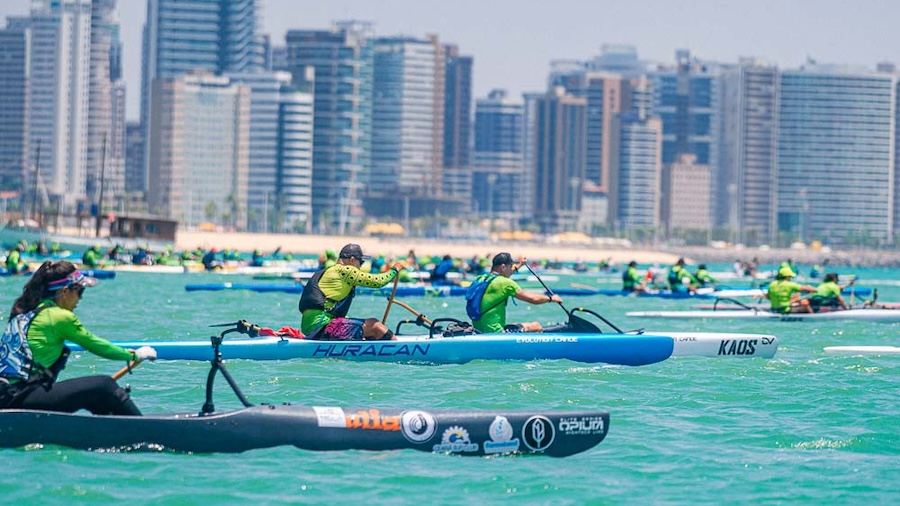
At the 2025 edition of the VIBE Volta de Ilhabela, one team stood out not only for its performance, but for the method and vision behind it: ANALYTIC PADDLE, led by Arthur Santacreu. A former world-class athlete turned high-performance coach, Santacreu is one of the most respected figures in Brazilian paddle sports. He claimed the SUP sprint world title at the 2018 World Championships in China, added multiple Brazilian national titles to his résumé, and earned World Championship medals before shifting his focus to coaching and performance analysis.
In this interview, Arthur looks back on ANALYTIC PADDLE’s first team appearance at the VIBE, where strategy, science, and team cohesion were pushed to their limits over the demanding 90 km course around Ilhabela. He breaks down how the team was built, how it was prepared, and what this podium finish means for the future of ANALYTIC PADDLE.
Arthur, for those who may not know you yet, can you introduce yourself? Where do you live today, what does your family look like, what’s your sports background, and what do you consider your biggest achievements as a professional athlete?
Hi Mathieu! It’s a pleasure to talk with you. It was awesome to have you here at one of the most iconic races in Brazil!
About me? Well, I’m the youngest son of five! That kind of big family that is always together for Sunday lunch. We were all influenced by our parents to practice sports. My dad was a Brazilian windsurfing champion before he had kids, competed at world championships, and started boat sailing when we were born. Maybe he was trying to build his own boat crew for bigger boats with his kids? Hahahaha!
We started paddling va’a as a family team, and SUP came along almost like a combo in Brazil! Individually, I started to focus on SUP sprint, becoming a 3x Brazilian sprint champion and finishing top 5 in technical and long-distance races here. In 2017, I won a bronze medal at the World Championships and became sprint World Champion in 2018 in China! That title was extra special for me because I was studying at two different universities at the same time and somehow managed to train at an elite level!
You’ve transitioned from world-class athlete to coach. What is Analytic Paddle exactly? How did it start, what’s the philosophy behind it, and who is it for?
I got my degree in engineering and sports science, and in 2019 I started to focus on becoming a coach. I won my second bronze medal, and then COVID started. With that, I decided to focus on others. I was already super happy with my achievements, and I wanted to help people achieve their goals too!
I always say that I didn’t become world champion because of my talent! I don’t think I actually have it! I believe my world title came from my analytical approach as an engineer, mixed with my physiological and biomechanics knowledge from sports science. That’s actually why it’s named ANALYTIC PADDLE—it summarizes my approach very well. I wanted to bring more science to paddle sports!
Can you introduce the full Analytic Paddle team you brought to the VIBE Volta de Ilhabela 2025? Who were the athletes, what were their roles or strengths, and how did you build the team dynamic for such a demanding 90 km relay?
So, the team was made up of mixed athletes from around the country. Half of them paddled only on flatwater (lagoons), and the other half were used to the ocean conditions we have here in Ilhabela. From my perspective, they were separated into three groups: the six flatwater guys (very strong and part of the same team), four ocean guys (also part of the same team), and two ocean guys who had never paddled together. The flatwater guys were the engine, and the ocean guys were the ones who made the engine work properly on the ocean.
How did you specifically prepare your team for a 90 km race around an island? Training structure, analytics, equipment, mental preparation—what were the pillars of your approach given the team comes from all around the country?
The training program was based not on pure endurance, but on the capacity to sustain high intensity and recover fast. Each athlete would paddle 45 km, but training for 45 km nonstop is very different from paddling 45 km with 20 minutes of recovery between the next 20 minutes of intense paddling. So the training sessions were focused on mimicking the race, as they were already trained for regular endurance races. But the key was more about the seats.
The strategy was to keep athletes who were used to paddling together, as synchronization is the most important part of a six-man canoe. Both seat 6 paddlers were very good in ocean conditions, so I took one of the strongest flatwater guys and moved him to help the ocean team. I replaced him with the most experienced ocean paddler.
So, on Team A, we had four strong flatwater paddlers with a very good seat 6 and one very good ocean paddler as the captain, changing from seat 3 to seat 1 depending on the conditions, guaranteeing they would paddle the waves properly. Team B had four ocean paddlers used to paddling together (seat 6 included), one more experienced ocean athlete, and the strongest flatwater guy to add extra power to the team.
Everybody connected really fast, which is very important to keep the energy in a race like that. I explained all the possible scenarios we would face so we could follow the strategy and not get caught by surprise. They all knew how to act.
What was your race strategy during the Volta de Ilhabela? How did you manage team rotations, pacing, stroke rhythms, and rhythm changes across such a long and varying course?
I knew the other teams were very strong at the start, and my team needed some time to adjust as a real team. So we kept the pace very constant, avoiding early fatigue. Ninety kilometers is all about managing energy and fatigue. If you push the intensity too high at the beginning, you’ll pay the price later.
I knew the other teams would slow down eventually. During the first third of the race, they were far ahead of us—we were in 4th position and more than 500 meters behind 3rd place. But in the second third, we were much faster, passed 3rd place incredibly fast, and opened a gap of more than two minutes. With the team paddling very well in ocean conditions, we caught second place.
After battling with SAMU for second place for a while, the water started to get flat, and SAMU responded really well. The ocean paddlers from our team were key to pacing the race in seat 1 while we had waves, and we switched them for stronger paddlers when we had more flat water. The boys always kept positive energy, enjoying the race and trusting each other.
What were the hardest parts of the race—for you as a coach and for the athletes? Conditions, logistics, fatigue, decision-making… what really challenged you out there?
For the athletes, the hardest part was the last 12 km battling against SAMU, for sure. Moving from 4th to 2nd place at the best point of the race cost a lot of energy, and during that battle the boys were close to exhaustion.
For me, I had different challenges. The first was preventing them from pushing too hard so they could sustain the pace better, and the second was not being able to paddle with them and help the team. It was hard to just watch! That made me think about paddling next year. Let’s see if I can manage training myself with my second baby on the way! I’ll have to find some time! But I won’t be on the team if I’m not one of the best paddlers. I’ll be there—again as a coach or as a paddler!
Your team finished 3rd—an amazing result. Were you fully satisfied? What do you think could have been improved to climb even higher on the podium?
I’m super happy with 3rd place! That was the first time I had an ANALYTIC team. We impressed a lot of people! Honestly, to get a better result, we need to train together as a team. That’s the focus for 2026!
What are your goals now for next season, including the 10th edition of the Volta and the broader roadmap for Team Analytic?
In 2026, I’m focusing on having two different teams to represent ANALYTIC PADDLE: one for sprint and the other for long distance. These teams will race in the first semester at the national championships. Sprint and long distance are one month apart, so it’s not a good idea to have the same team for both.
In the second semester, I will start to bring both teams together in training camps to prepare for the 10th edition of VIBE. It’s going to be epic to have a team trained together!
Thank you for the chat, Mathieu! Always a pleasure! I hope to see you more often in Brazil!
A 9ª edição da VIBE – Volta de Ilhabela confirmou mais uma vez o lugar único do evento no calendário da canoagem. Realizada todos os anos no primeiro final de semana de dezembro, a VIBE é uma prova de revezamento de 90 quilômetros aberta a todas as embarcações de remo sentado, sendo especialmente popular entre […]
The 9th edition of VIBE – Volta de Ilhabela once again confirmed the event’s unique place on the paddling calendar. Held every year on the first weekend of December, VIBE is a 90-kilometer relay race open to all seated paddle crafts, while remaining especially popular with OC6 and V6 teams. This year marked record participation, […]
On December 5 and 6, the 9th edition of VIBE, the Volta de Ilhabela 90K will bring together hundreds of paddlers for one of Brazil’s most iconic ocean challenges. Created in 2016 by Marcos Möller, VIBE has grown from a local passion project into one of the country’s most anticipated endurance races, attracting athletes from […]
In Brazil, where the ocean shapes both culture and identity, a new era of paddlesports is rising, and few embody this movement as powerfully as Ulisses Calenti. Entrepreneur, producer, and dedicated Va’a athlete, Ulisses has spent more than a decade building bridges between passion, performance, and community. From São Paulo to the windswept coastline of […]
This season has been a exciting one for Marton Buday, founder and athlete of NALU Canoes. Dividing his time between racing and developing the brand, Márton continues to build a connection between performance on the water and design in the workshop. His approach remains consistent: test, refine, and apply what he learns in competition to […]
Canoe Ocean Racing is set to take a major step forward in 2026 with the International Canoe Federation confirming four-stop World Cups spanning Brazil, France, Malaysia, and Tahiti. For the first time, athletes will have the opportunity to compete in an international circuit dedicated to surfski racing, with events strategically placed across the globe. The […]
A few hours before the start of the Molokabra, we had the chance to sit down with one of the key figures shaping the growth of va’a in Brazil: Lígia Felismino. Architect by profession and paddler by passion, Lígia discovered canoeing in 2021 and quickly embraced the sport as a lifestyle, balancing her love for […]
Get ready for an unforgettable week of racing at the 2025 Va’a World Long Distance Championship, taking place from August 13 to 21 in the stunning city of Niterói, just across the bay from Rio de Janeiro, Brazil! This iconic event brings together the best paddlers from around the globe for a celebration of Polynesian […]
Historic Weekend in Salvador, Bahia: the 2025 Brazilian Va’a Championship Breaks Records The first-ever Brazilian Va’a National Championship or “Campeonato Brasileiro de Va’a” to take place in the North-East made history last weekend in Salvador, Bahia, delivering an unforgettable spectacle of speed, endurance, and team spirit. With record participation, ideal race conditions, and a vibrant […]