Performance jerseys and rash guards are essential pieces of equipment for many ocean sports athletes, from surfski and outrigger canoe paddlers to SUP and kayak enthusiasts. But beyond comfort and appearance, how much do we really know about the fabrics, technology and protective features behind these garments?
What does UPF 50+ actually mean? Which fabrics work best in hot conditions? How should a performance jersey fit, and what can paddlers do to preserve its technical properties over time?
To answer these questions, we invited Christoph Renger from SKILD, a performance apparel brand developed to meet the specific needs of the ocean paddling community, to share his expertise and help us put together a practical guide for paddlers.
From UV protection and fabric technology to fit, durability, washing and maintenance, this guide covers the key things athletes should know when choosing and caring for their performance paddling apparel.
What is the difference between a rash guard, a UV-protective swim shirt and a performance paddle jersey?
They all look a bit alike on a hanger, but they’re built for very different days at the beach. Think of it like shoes. Flip-flops, running shoes and hiking boots all go on your feet, but you wouldn’t run a marathon in flip-flops (well, you could, but you’d only do it once).
What does UPF 50+ mean in practical terms, and how does it differ from SPF?
SPF protects against UVB, while UPF protects against both UVA and UVB.
Easy to remember: UV-A causes “A-geing” and UV-B causes “B-urning”.
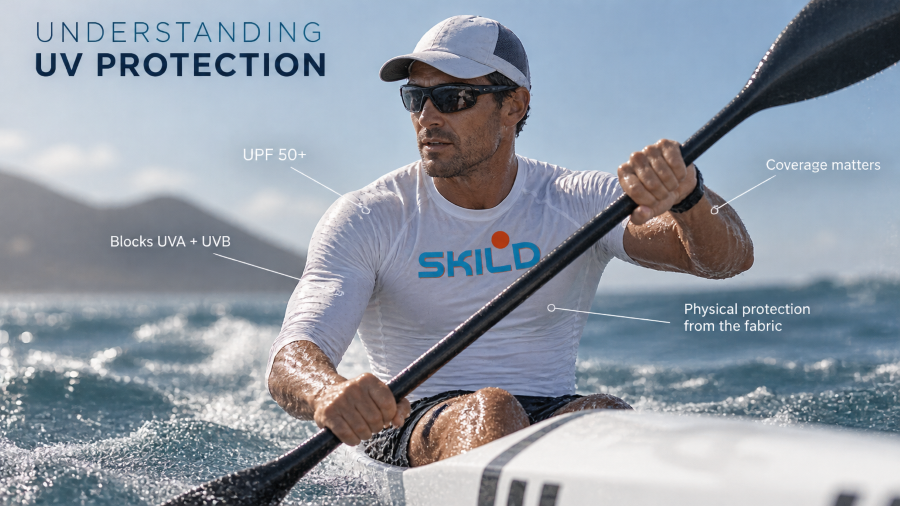
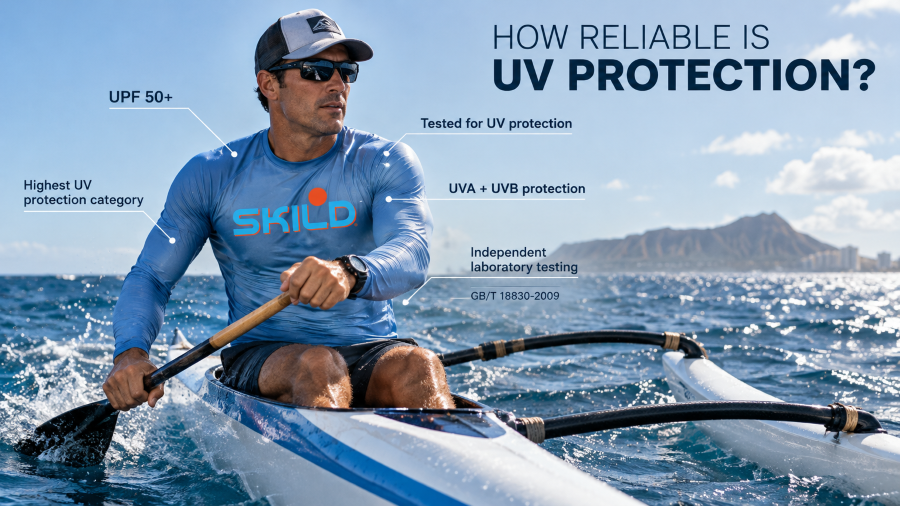
UPF is for fabric and stands for Ultraviolet Protection Factor. It tells you how much UV radiation gets through a fabric. UPF 50 means only 1/50 of the UV radiation reaches your skin, so the fabric blocks about 98%. The “+” means it tested at 50 or higher, which is the top category on most rating scales.
Practical translation: if the sun is throwing 50 punches at you, a UPF 50+ shirt lets one through. Not bad odds.
UVA is the sneaky one: it doesn’t burn you much, but it goes deeper into the skin and contributes to ageing and skin damage.
Sunscreen only hits its SPF number if you apply a proper, generous layer (most people use maybe a third to half of what the lab used), don’t miss any spots and reapply regularly. Then you jump in the water, wipe your face with a salty hand, sweat for two hours… and that SPF 50 is now more like “SPF good intentions”.
A UPF 50+ shirt doesn’t sweat off, doesn’t wash off, doesn’t need reapplying at the 10 km mark, and you can’t “forget a spot” on your back. Put it on, done.
Does UV protection decrease over time? What factors determine how long a rash guard maintains its original UPF rating?
Generally speaking, polyester is the best fabric for achieving a higher UPF rating. A “normal”, densely knitted shirt will have a UPF rating of 15–20, which already provides over 90% UV protection. To reach 50+, you either need a very densely knitted or woven fabric, or a chemical treatment. This protection can decrease after many wash cycles. Overstretched fabric (not a tight fit or compression fit, but seriously undersized clothing) can also reduce UPF protection.
A good way to make it last longer is to rinse your shirt thoroughly after each use, before washing it.
What should paddlers look for in a performance jersey designed for long sessions in surfski, outrigger canoe, SUP or kayak? Which features make the biggest difference during repetitive paddling movements and extended exposure to the sun?
Short answer:
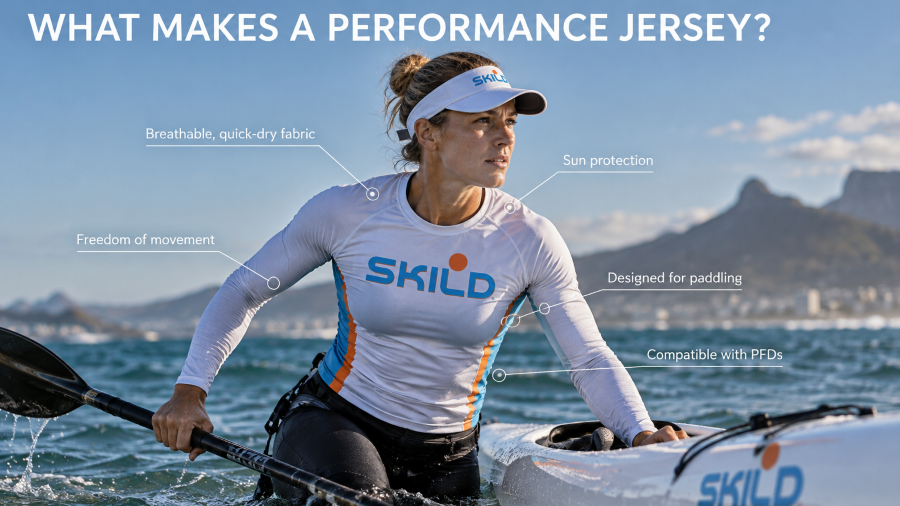
1. A cut made for rotation and reach.
2. Fabric that breathes and dries fast (moisture-wicking and quick-drying, like Dri-FIT).
3. Reliable sun protection built in.
4. Seams that cause no trouble.
5. Compatibility with your gear, e.g. PFDs (waist or jacket style).
6. Prints: ideally, the design should be sublimated rather than screen-printed, which seals off the fabric.
7. Visibility and colour on the water: colours like red, orange and yellow work better. Lighter colours can also reflect more sunlight and feel cooler.
8. Freshness for the long haul: odour can become a serious issue if you use your shirts multiple times per week. Keeping them fresh is essential. Your crew sitting behind or near you will thank you, even if they don’t say it out loud 😉
I could go into plenty more detail on many of these points and do some deep dives, but I guess the important points are covered above.
How should a performance jersey fit? How can paddlers balance freedom of movement, comfort, chafe prevention and adequate skin coverage?
The headline should be: Fitted, not squeezed.
A good paddle jersey should sit close to the body without gripping it. Think “second skin with a bit of breathing room”, not “vacuum-packed”.
Here are a few guidelines:
Freedom of movement
Comfort
Chafe prevention
Skin coverage
A few extra tips
Between two sizes?
Think about how you use it. For long sessions with a PFD on top, many paddlers prefer the slightly roomier option. For racing without much gear, the closer fit often wins. If possible, try both with the paddle test.
Fabric changes when wet.
Some fabrics stretch or cling more once soaked. A good performance fabric keeps its shape, but expect it to feel a little different on the water than in the fitting room.
Your body changes during a season.
Training blocks, race prep, holiday season (we’ve all been there). A jersey with a bit of stretch handles that better than one that only fits on your best day.
THE BOTTOM LINE
The right fit is the one you forget about.
Which fabric properties matter most for paddling in hot weather? How should users balance breathability, quick drying, stretch, durability and UV protection?
In my opinion, two properties go hand in hand:
1. Breathability.
2. Fabric weight per square metre (GSM).
3. Quick drying: polyester or nylon doesn’t hold water compared to cotton, for example.
4. Stretch: enough, but not too much. Four-way stretch should be non-negotiable.
5. Durability: a stable structure that maintains its shape and performance throughout the product’s lifespan.
What are the best ways to wash and dry a performance jersey to preserve its technical properties? How should users deal with saltwater and chlorine, and which detergents, products or practices should they avoid?
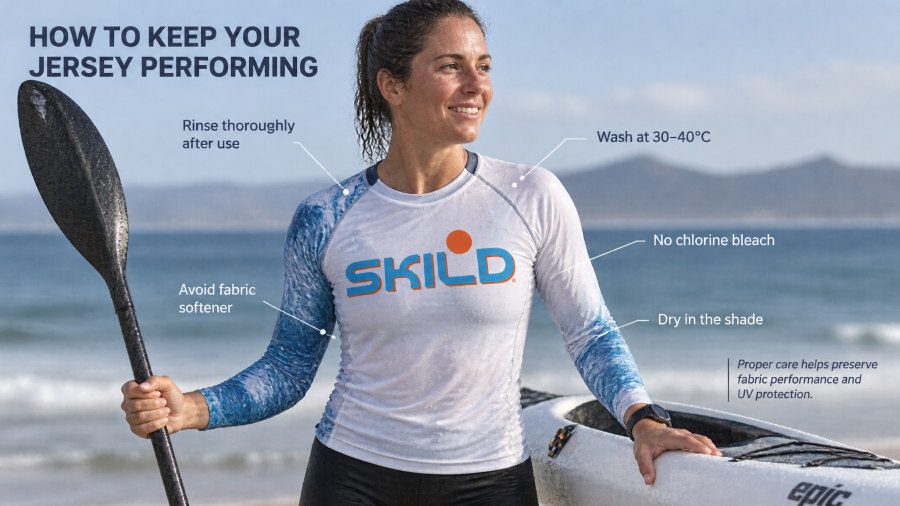
1. The number one care instruction would be: RINSE WELL!
2. Don’t use fabric softener! This will clog up the fabric and increase the likelihood of odour development. Don’t use bleach or chlorine-based stain removers, as these will damage elastane and polyester fibres.
3. Wash at a cold or lukewarm temperature (86–104°F / 30–40°C).
4. Wash inside out: this protects the sublimation print and turns the sweaty side towards the detergent.
5. Wash with similar items: keep the jersey away from Velcro or wash it in a laundry bag.
6. Hang to dry, indoors or outdoors, but not in direct sunlight. If you dry it in sunlight, turn it inside out.
For stubborn odours, you can add some plain vinegar to your wash or soak the jersey in baking soda and vinegar before washing.
Real-life example
Two paddlers buy the same jersey on the same day. One rinses it at the beach, washes it cold and hangs it in the shade. The other leaves it in the dry bag in the car for the weekend, washes it hot with fabric softener “to make it nice” and tumble-dries it. Six months later, the first jersey still looks and feels new. The second one has lost its stretch, smells a bit like the inside of an old dragon boat and no longer wicks sweat. Same jersey, very different life.
What signs indicate that a rash guard is no longer performing as intended, and when should it be replaced? Is there a reliable way to estimate a garment’s useful lifespan?
1. The most evident sign would be something like redness on the shoulders or back, indicating sunburn.
2. If the shirt hangs baggy and has lost its shape.
3. When stretching it doesn’t “bounce back”.
4. It stays wet longer than usual, smells or causes chafing.
5. When you hold it up to the light or sun, you can see the fabric thinning in some places.
If two of the above apply, it’s time to get yourself a new one.
There is no formula to calculate the lifespan. For our shirts, we still have testers out there with very sensitive skin who are using our first prototypes from three years ago.
How can consumers verify a garment’s UPF claims? Which testing standards, certifications or product information should they look for when assessing the reliability of UV protection?
There are quite a few labs that carry out these tests, and they are usually very reliable. Institutes such as Germany’s TÜV operate internationally, and there are also many institutes in China that carry out very reliable testing for the huge apparel industry that exports to the rest of the world.
There are multiple standards across different regions that document the same thing.
There are a few laundry detergents that claim to create UV protection, but I wouldn’t waste my money on those.
Our certification is UPF 50+.
SKILD fabric was tested to GB/T 18830-2009, the Chinese national standard “Textiles – Evaluation for the protective properties against solar ultraviolet radiation”, and rated in its top category, “UV protective product”.
Verification: the report can be checked online at www.fcl-sz.org.cn using anti-counterfeit code 1236786633.
The UVA requirement is similar to the European EN 13758 approach, so this standard is stricter than just a UPF number.
Our test was conducted using white fabric. White is usually the hardest case because colours add UV absorption.
Drawing on SKILD’s expertise in performance apparel, what technical features and construction details make the biggest difference in a jersey’s long-term performance? How does SKILD approach fabric selection, UV protection and durability when developing its products?
Any jersey can feel great on day one. Fresh out of the bag, everything is soft, bright and stretchy. The real test is month eight, after a hundred sessions, salt, sweat, sunscreen and a few “I’ll rinse it later” moments. A good jersey is like a good crew member: it’s not about how it looks at the start line, it’s about whether it’s still pulling its weight at the end.
What actually makes a jersey last
1. A stable fabric structure
How a fabric is knitted matters as much as what it’s made of. Warp-knit fabrics, like the mesh we use at SKILD, are built with interlocking loops running lengthwise, which makes them more dimensionally stable and more resistant to running or laddering than many standard knits. In plain English: it holds its shape better and doesn’t start sagging after a season of rotation and reach.
2. UV protection and odour prevention that’s built in, not sprayed on
If the UPF comes from a chemical finish, every wash takes a little away. If it comes from the fibre and the fabric structure, it stays as long as the fabric stays intact. That’s the kind you want for something you’ll wear hundreds of times.
Our organic graphene/charcoal fibres act as an anti-odour additive, but never wash out, and are natural fibres.
3. Colour that’s part of the fabric
Sublimation printing dyes the design into the polyester fibres instead of laying a layer on top. No cracking, no peeling, no plastic patch on your back that blocks airflow. A jersey with a big rubbery print often looks tired long before the fabric does.
4. The right amount of stretch
Elastane gives freedom of movement, but it’s also usually the first part of a fabric to wear out, especially with heat, chlorine and UV. Enough stretch to move, combined with a cut that gives your shoulders room, ages much better than a fabric that has to stretch hard on every stroke.
5. Seams built for repetition
Thousands of strokes per session put serious, repeated stress on seams. Flat construction, good stitch quality and placement away from high-friction zones (underarms, shoulder tops, PFD straps) make the difference between a jersey that lasts and one that starts unravelling or chafing after a few months.
6. Pilling and abrasion resistance
Seats, hulls, PFDs and hydration vests all rub against your jersey. Fabrics that resist pilling and thinning keep both their comfort and their UV protection longer, because thin spots are where protection drops first.
How SKILD approaches it
We start with the conditions, not the catalogue.
SKILD was born in Singapore, where paddling means heat, humidity and strong sun pretty much every day of the year. So our first question is never “what looks good on the rack?” but “what does a paddler actually need after two hours on the water at 32°C?” That’s why breathability and cooling sit right at the top of our list, next to sun protection.
Our current jerseys use a lightweight bamboo charcoal warp-knit mesh. The open structure lets heat and moisture escape, the polyester base dries fast and takes sublimation printing beautifully, and the warp-knit construction keeps it stable over time. The challenge with any breathable fabric is making sure “open” doesn’t mean “lets the sun through.” Which brings us to…
UV protection: tested, not just claimed.
We had our fabric tested by an accredited independent lab (United Testing Services Fujian, CNAS L5773) to the Chinese national standard GB/T 18830, which requires both a UPF above 40 and less than 5% UVA transmission. Our fabric measured an average UPF of 71.6, with just 1.67% UVA and 1.31% UVB getting through. That was on white fabric, typically the toughest case. We’re happy to share the report with anyone who asks.
Durability: built in from the start.
Stable knit, built-in UPF, sublimated colour and paddler-specific construction all exist so the jersey keeps doing its job long after the first session, not just in the product photos.
Honesty about what we know and what we’re still testing.
A lab test on new, dry fabric is a great starting point, but paddlers don’t paddle in a lab. That’s why we’re working towards testing our fabrics under more realistic conditions, including controlled studies with elite athletes here in Singapore. And we’re always developing: new lightweight fabrics and products for different conditions are in the pipeline, because “good enough” isn’t really how a world champion paddler thinks about gear.
Real-life example
Most paddlers have a drawer with three kinds of shirts: the one that looked amazing for a month, the one that’s indestructible but feels like a sauna, and the one they actually reach for every time. Our goal is simple: be the third one, and stay the third one for a long time.
The bottom line
Long-term performance comes from the details you can’t see on day one: a stable fabric, built-in UV protection, a print that’s part of the fibre, sensible stretch and seams made for thousands of strokes. At SKILD, we choose fabrics for real tropical paddling, verify our UV claims with independent testing, and keep pushing to prove our gear in conditions that actually look like a race day.
What guidance does SKILD provide to customers to help them get the most out of their performance jerseys? What are your key recommendations for choosing, caring for and maintaining a jersey, and how can customers find the right information for their specific needs?
We have all the care instructions on our website, and I think we’ve given your readers all the answers in the questions above. I can’t really say we’ve missed out on anything…
Thanks for asking!
About SKILD
SKILD is a Singapore-based performance-wear brand focused on technical apparel for paddlers and athletes training and racing outdoors.
You’re lined up at the start. The sun is already high, the water is glittering, and you know you’ll spend the next hour – or the next five – with no shade at all. Your kit suddenly becomes part of the race plan. A short-sleeve top feels like the obvious choice. Less fabric, more air, […]
The world’s biggest Va’a sprint showdown is about to begin! From August 17 to 31, Marina Bay in Singapore will welcome 2,222 athletes from 29 countries and territories for one of the biggest celebrations of Va’a racing in the world. Expect spectacular sprint racing, explosive speed, precision and fierce competition, alongside the Polynesian traditions and […]
Based in Singapore and born from a genuine passion for paddling, SKILD is building a name for itself with technical apparel designed specifically for life on the water. At the heart of the brand is co-founder Christoph Renger, an active Dragon boat, OC and Va’a paddler who understands first-hand the demands of long hours in […]
With the 2026 World Srint Championships in Singapore just weeks away, the Tahitian Va’a selection is entering the final stages of its preparation. During the team’s penultimate training session in Tahiti, we caught up with Gordon Barff, Technical Director of the Tahitian Va’a Federation, to discuss the selection process, the challenge of bringing together the […]
With just a few weeks to go before the 2026 Va’a World Sprint Championships in Singapore, Tahitian Va’a coach Philippe Bernadino is entering the final stages of preparation with the national selection. After months of selection and training, the focus is now on fine-tuning the crews, building cohesion and making sure every paddler is ready […]